
RPO vs. RTO: How to Test Whether Your Recovery Plan Can Meet Both
Published 2026-09-05 | JiWang Data Recovery Technical Team

RPO and RTO answer different recovery questions. Recovery point objective limits how much recent data an organization can afford to lose, while recovery time objective limits how long a service can remain unavailable. A backup schedule may support an RPO on paper, but only a timed restore exercise can test the RTO.
RPO and RTO are not backup settings
An RPO of four hours means the recovery process should be able to return data to a point no more than four hours before the disruption. It does not mean that a backup must run only once every four hours. Replication delay, failed jobs, retention, application consistency, and the time needed to discover corruption can all widen the real recovery gap.
An RTO of eight hours means the organization intends to restore the required service within eight hours. Copying files back is only one part of that period. Infrastructure provisioning, identity recovery, database replay, application checks, security validation, user acceptance, and network changes also consume time.
The NIST contingency planning guidance treats recovery as a coordinated plan involving people, procedures, priorities, alternate resources, and technical measures. That is why a successful backup job is evidence of data capture, not proof of recoverability.
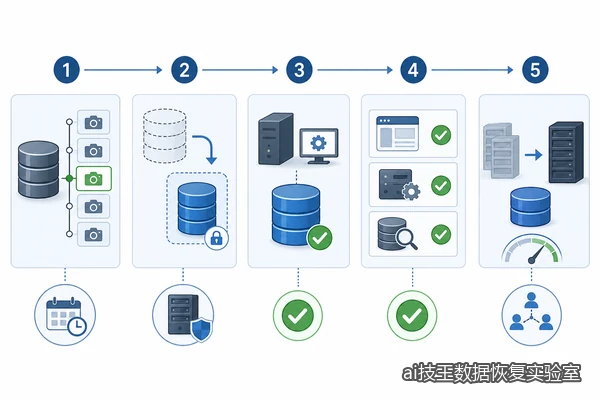
Build a test that measures the real objectives
Start with one business service, not an entire data center. Record its dependencies: identity, DNS, secrets, databases, file stores, queues, certificates, network routes, and external services. Select a documented recovery point and restore it into an isolated environment where it cannot overwrite production or reconnect to a compromised network.
Measure at least five timestamps:
- Incident declaration and authorization to recover.
- Recovery point selection and media availability.
- Infrastructure ready for data restoration.
- Data restored and integrity checks completed.
- Application accepted for controlled service return.
The difference between the selected recovery point and the last valid business transaction measures effective data loss. The time from declaration to accepted service measures recovery time. If either target is missed, record the dependency or decision that caused the delay rather than simply increasing the target after the exercise.
Validate more than file presence
A useful recovery test checks whether the restored data is coherent and usable. For a database, validate consistency and application transactions. For a file service, inspect permissions, ownership, representative files, directory structure, and expected versions. For virtual machines, verify configuration, attached disks, networking, and boot behavior.
Security validation is equally important. The CISA StopRansomware Guide recommends offline, encrypted backups and regular tests of backup availability and integrity in a disaster recovery scenario. It also warns against reconnecting contaminated systems during recovery. A fast restore that reintroduces malware does not meet a safe RTO.
Common reasons recovery exercises fail
- The backup account depends on the same identity system that must be recovered.
- Encryption keys or application secrets are unavailable outside production.
- Documentation lists servers but omits service dependencies and recovery order.
- Restore bandwidth was estimated from backup speed rather than measured restore speed.
- Snapshots share the same administrative control and failure domain as production.
- Teams test data restoration but skip application and user acceptance.
- The exercise uses a clean sample while the real incident would require forensic preservation.
These failures are valuable findings when discovered during a controlled exercise. The corrective action may be architectural, procedural, or contractual; buying more storage alone will not solve every gap.
A practical quarterly recovery scorecard
For each critical service, retain the planned RPO and RTO, selected restore point, actual data gap, actual elapsed time, integrity result, application result, security result, unresolved dependencies, and named owner. Track trends across exercises. An objective repeatedly met under ideal conditions but missed when identity or networking is unavailable needs a more realistic test scenario.
Recovery objectives should also reflect business priorities. Restoring a large archive before identity, communications, or a transaction system may consume capacity without reducing operational impact. A business impact analysis should decide the order before an incident, when time pressure and incomplete information make prioritization harder.
Sources
- NIST SP 800-34 Rev. 1: Contingency Planning Guide for Federal Information Systems
- CISA StopRansomware Guide
Sources checked September 5, 2026.
Frequently Asked Questions
Can snapshots satisfy an RPO?
Snapshots may provide frequent recovery points, but they do not automatically satisfy an RPO. Confirm retention, consistency, administrative isolation, replication status, and whether the snapshot survives the same storage failure or ransomware event as production.
Does a successful restore prove the RTO?
Only if the exercise measures the complete service recovery path. File restoration alone excludes infrastructure, identity, application validation, security checks, user acceptance, and the controlled return to service.
How often should recovery tests run?
Frequency should follow system criticality, rate of change, regulatory needs, and architecture changes. Critical services may need more frequent component tests plus periodic end-to-end exercises. Every major platform, identity, encryption, or backup change should trigger targeted retesting.
Should ransomware recovery use the fastest available restore point?
Not automatically. The newest point may contain malicious persistence or corrupted data. Select the newest point that is both technically consistent and supported by incident evidence, then restore it in an isolated environment for validation.